Thursday, August 17, 2017

 Dulce et decorum est,        by Wilfred Owen

Bent double, like old beggars under sacks,
Knock-kneed, coughing like hags, we cursed through sludge,
Till on the haunting flares we turned our backs,
And towards our distant rest began to trudge.
Men marched asleep. Many had lost their boots,
But limped on, blood-shod. All went lame; all blind;
Drunk with fatigue; deaf even to the hoots
Of gas-shells dropping softly behind.

Gas! GAS! Quick, boys!—An ecstasy of fumbling
Fitting the clumsy helmets just in time,
But someone still was yelling out and stumbling
And flound’ring like a man in fire or lime.—
Dim through the misty panes and thick green light,
As under a green sea, I saw him drowning.

In all my dreams before my helpless sight,
He plunges at me, guttering, choking, drowning.

If in some smothering dreams, you too could pace
Behind the wagon that we flung him in,
And watch the white eyes writhing in his face,
His hanging face, like a devil’s sick of sin;
If you could hear, at every jolt, the blood
Come gargling from the froth-corrupted lungs,
Obscene as cancer, bitter as the cud
Of vile, incurable sores on innocent tongues,—
My friend, you would not tell with such high zest
To children ardent for some desperate glory,
The old Lie: Dulce et decorum est
Pro patria mori.

Latin phrase from the Roman poet Horace: “It is sweet and fitting to die for one’s country.”     From:  Poems (Viking Press, 1921)

Thursday, August 3, 2017

The House Was Quiet and the World Was Calm, by Wallace Stevens


The house was quiet and the world was calm.
The reader became the book; and summer night

Was like the conscious being of the book.
The house was quiet and the world was calm.

The words were spoken as if there was no book,
Except that the reader leaned above the page,

Wanted to lean, wanted much to be
The scholar to whom his book is true, to whom

The summer night is like a perfection of thought.
The house was quiet because it had to be.

The quiet was part of the meaning, part of the mind:
The access of perfection to the page.

And the world was calm. The truth in a calm world,
In which there is no other meaning, itself

Is calm, itself is summer and night, itself
Is the reader leaning late and reading there.


"The House Was Quiet and the World Was Calm" by Wallace Stevens 

from The Collected Poems of Wallace Stevens. © Vintage, 201

Tuesday, June 27, 2017

Plentitude, by Ann Iverson

 Even near the very end
the frail cat of many years
came to sit with me
among the glitter of bulb and glow
tried to the very last to drink water
and love her small world
would not give up on her curious self.
And though she staggered — shriveled and weak
still she poked her nose through ribbon and wrap
and her peace and her sweetness were of such
that when I held my ear to her heart
I could hear the sea.


"Plentitude" by Ann Iverson from Mouth of Summer
© Kelsay Books, 2017.

Saturday, May 27, 2017

The Bookstall, by Linda Pastan

Just looking at them
I grow greedy, as if they were
freshly baked loaves
waiting on their shelves
to be broken open—that one
and that—and I make my choice
in a mood of exalted luck,
browsing among them
like a cow in sweetest pasture.

For life is continuous
as long as they wait
to be read—these inked paths
opening into the future, page
after page, every book
its own receding horizon.
And I hold them, one in each hand,
a curious ballast weighting me
here to the earth.


"The Bookstall" by Linda Pastan 

from Carnival Evening. © Norton, 1998.

Tuesday, May 9, 2017


In Spring
by Rosie King

I’m out with the wheelbarrow mixing mulch.
A mockingbird trills in the pine.
Then, from higher, a buzz, and through patches of blue
as the fog burns off, a small plane pulls a banner,
red letters I can’t read—
but I do see, over the fence,
a man in a sky-blue shirt walking his dog to the beach.
He says he missed it, will keep an eye out.
Four barrows of mulch around the blueberry bushes,
I’m pulling off gloves, and he’s back, beaming.
“It says, I LOVE YOU, MARTHA.
Are you Martha?”


"In Spring" by Rosie King from Time and Peonies. © Hummingbird Press, 2017.

A little "smile of a poem."

Monday, May 1, 2017

Under the Stars
by Dorianne Laux

When my mother died
I was as far away
as I could be, on an arm of land
floating in the Atlantic
where boys walk shirtless
down the avenue
holding hands, and gulls sleep
on the battered pilings,
their bright beaks hidden
beneath one white wing. 
 
Maricopa, Arizona. Mea Culpa.
I did not fly to see your body
and instead stepped out
on a balcony in my slip
to watch the stars turn
on their grinding wheel. 
Early August, the ocean,
a salt-tinged breeze.
 
Botanists use the word
serotinous to describe
late-blossoming, serotinal
for the season of late-summer.
I did not write your obituary
as my sister requested, could
not compose such final lines:
I closed the piano
to keep the music in.
Instead
 
I stood with you
on what now seems 
like the ancient deck
of a great ship, our nightgowns
flaring, the smell of dying lilacs
drifting up from someone’s
untended yard, and we
listened to the stars hiss
into the bent horizon, blossoms
the sea gathered tenderly, each
shattered and singular one
long dead, but even so, incandescent,
making a singed sound, singing
as they went.
 

Sunday, April 30, 2017

 Afternoon on a Hill
by Edna St. Vincent Millay

 I will be the gladdest thing
    Under the sun!
I will touch a hundred flowers
    And not pick one.
 
I will look at cliffs and clouds
    With quiet eyes,
Watch the wind bow down the grass,
    And the grass rise.
 
And when lights begin to show
    Up from the town,
I will mark which must be mine,
    And then start down!

(I have stood on this hill in Camden, Maine, 
looked down, and thought of this poem.  Lovely.)

Poem now in the public domain.

Tuesday, April 11, 2017


Reminder


I am rich I am poor. Time is all I own.
I spend or hoard it for experience.
By the bitten wound the biting tooth is known.

Thrift is a venomous error, then, a stone
named bread or cash to support the pretense
that I’m rich. I am poor; time is all I own...

though I hold to memory: how spent time shone
as you approached, and the light loomed immense.
By the bitten wound the biting tooth is known,

though scars fade. I have memory on loan
while it evaporates; though it be dense
& I am rich, I am poor. Time is all I own

to sustain me—the moonlit skeleton
that holds my whole life in moving suspense.
By the bitten wound the biting tooth is known.

Ownership’s brief, random, a suite of events.
If the past is long the future ’s short. Since
I am rich I am poor. Time is all I own.
By the bitten wound the biting tooth is known.

Marie Ponsot, Collected Poems, Knopf

Wednesday, March 15, 2017


Home
by William Stafford

Our father owned a star,
and by its light
we lived in father’s house
and slept at night.


The tragedy of life,
like death and war,
were faces looking in
at our front door.


But finally all came in,
from near and far:
you can’t believe in locks
and own a star.


"Home" by William Stafford 
from Another World Instead
© Graywolf Press, 2008.

Monday, February 20, 2017


Protest
by Ella Wheeler Wilcox


To sin by silence, when we should protest,
Makes cowards out of men. The human race
Has climbed on protest. Had no voice been raised
Against injustice, ignorance, and lust,
The inquisition yet would serve the law,
And guillotines decide our least disputes.
The few who dare, must speak and speak again
To right the wrongs of many. Speech, thank God,
No vested power in this great day and land
Can gag or throttle. Press and voice may cry
Loud disapproval of existing ills;
May criticize oppression and condemn
The lawlessness of wealth-protecting laws
That let the children and childbearers toil
To purchase ease for idle millionaires.
 
Therefore I do protest against the boast
Of independence in this mighty land.
Call no chain strong, which holds one rusted link.
Call no land free, that holds one fettered slave.
Until the manacled slim wrists of babes
Are loosed to toss in childish sport and glee,
Until the mother bears no burden, save
The precious one beneath her heart, until
God’s soil is rescued from the clutch of greed
And given back to labor, let no man
Call this the land of freedom.

"Protest" was published in Poems of Problems by Conkey Company, 1914.

Friday, February 17, 2017

Ars Poetica #100: I Believe


by Elizabeth Alexander
 
Poetry, I tell my students,
is idiosyncratic. Poetry

is where we are ourselves
(though Sterling Brown said

“Every ‘I’ is a dramatic ‘I’”),
digging in the clam flats

for the shell that snaps,
emptying the proverbial pocketbook.

Poetry is what you find
in the dirt in the corner,

overhear on the bus, God
in the details, the only way

to get from here to there.
Poetry (and now my voice is rising)

is not all love, love, love,
and I’m sorry the dog died.

Poetry (here I hear myself loudest)
is the human voice,

and are we not of interest to each other?

Friday, February 10, 2017

Ice Would Suffice


Friday, January 20, 2017

The Print the Whales Make

You and I on the boat notice
the print the whales leave,
the  huge ring their diving draws
for a time on the surface.
Is it like that when we
lose one another? Don't
know, can't. But
I want to believe
when we can no longer
walk across a room
for a hug, can no longer
step into the arms of the other,
there will be this:
some trace that stays
while the great body
remains below out of sight,
dark mammoth shadow
flick of flipper
body of delight
diving deep. 


by Marjorie Saiser from her book
I Have Nothing to Say About Fire
from Backwaters Press

Sunday, January 15, 2017


Descending Theology:  Christ Human
by Mary Karr

Such a short voyage for a god,
and you arrived in animal form so as not
to scorch us with your glory.
Your mask was an infant’s head on a limp stalk,
sticky eyes smeared blind,
limbs rendered useless in swaddle.
You came among beasts
as one, came into our care or its lack, came crying
as we all do, because the human frame
is a crucifix, each skeletos borne a lifetime.
Any wanting soul lain
prostrate on a floor to receive a pouring of sunlight
might–if still enough,
feel your cross buried in the flesh.
One has only to surrender,
you preached, open both arms to the inner,
the ever-present hold,
out-reaching every want. It’s in the form
embedded, love adamant as bone.
In a breath, we can bloom and almost be you. 


Poetry Magazine, December 2001, by Mary Karr

Tuesday, December 20, 2016

 Advent Calendar, by Gjertrud Schnackenberg
Bethlehem in Germany,
Glitter on the sloping roofs,
Breadcrumbs on the windowsills,
Candles in the Christmas trees,
Hearths with pairs of empty shoes:
Panels of Nativity
Open paper scenes where doors
Open into other scenes,
Some recounted, some foretold.
Blizzard-sprinkled flakes of gold
Gleam from small interiors,
Picture-boxes in the stars
Open up like cupboard doors
In a cabinet Jesus built.

Southern German villagers,
Peasants in the mica frost,
See the comet streaming down,
Heavenly faces, each alone,
Faces lifted, startled, lost,
As if lightning lit the town.

Sitting in an upstairs window
Patiently the village scholar
Raises his nearsighted face,
Interrupted by the star.
Left and right his hands lie stricken
Useless on his heavy book.
When I lift the paper door
In the ceiling of his study
One canary-angel glimmers,
Flitting in the candelabra,
Peers and quizzes him: Rabbi,
What are the spheres surmounted by?
But his lips are motionless.
Child, what are you asking for?
Look, he gazes past the roofs,
Gazes where the bitter North,
Stretched across the empty place,
Opens door by door by door.

This is childhood's shrunken door.
When I touch the glittering crumbs,
When I cry to be admitted,
No one answers, no one comes.

And the tailor's needle flashes
In midair with thread pulled tight,
Stitching a baptismal gown.
But the gown, the seventh door,
Turns up an interior
Hidden from the tailor's eyes:
Baby presents like the boxes
Angels hold on streets and stairways,
Wooden soldier, wooden sword,
Chocolate coins in crinkled gold,
Hints of something bought and sold,
Hints of murder in the stars.
Baby's gown is sown with glitter
Spread across the tailor's lap.
Up above his painted ceiling
Baby mouse's skeleton
Crumbles in the mouse's trap.

Leaning from the cliff of heaven,
Indicating whom he weeps for,
Joseph lifts his lamp above
The infant like a candle-crown.
Let my fingers touch the silence
Where the infant's father cries.
Give me entrance to the village
From my childhood where the doorways
Open pictures in the skies.
But when all the doors are open,
No one sees that I've returned.
When I cry to be admitted,
No one answers, no one comes.
Clinging to my fingers only
Pain, like glitter bits adhering,
When I touch the shining crumbs.

Gjertrud Schnackenberg, "Advent Calendar" from Supernatural Love: Poems 1976-1992
Copyright © 2000 by Gjertrud Schnackenberg.

Tuesday, October 11, 2016

A Small Story    
When Mrs. McCausland comes to mind
she slips through a small gap in oblivion
and walks down her front steps, in her hand
a small red velvet pillow she tucks
under the head of Old Jim Schreiber,
who is lying dead-drunk against the curb
of busy Market Street. Then she turns,
labors up the steps and is gone . . .

A small story. Or rather, the memory
of a story I heard as a boy. The witnesses
are not to be found, the steps lead nowhere,
the pillow has collapsed into a thread of dust . . .
Do the dead come back only to remind us
they, too, were once among the living,
and that the story we make of our lives
is a mystery of luminous, but uncertain moments,
a shuffle of images we carry toward sleep—
Mrs. McCausland with her velvet pillow,
Old Jim at peace—a story, like a small
clearing in the woods at night, seen
from the windows of a passing train. 


by Peter Everwine
 

Friday, April 15, 2016

Leave Me Hidden

I was having trouble deciding
which to watch: Night
of the Living Bloggers, or Attack of the Neck-Brace People.
In the end I just went for a walk. 

In the woods I stopped wondering why
of all trees
this one: my hand
pressed to fissures
and ridges of 

bark’s hugely magnified
fingerprint, forehead
resting against it
finally, feeling
distinctly 

a heartbeat, vast, silently
booming there deep in
my hidden leaves, blessed
motherworld, personal
underworld, thank you 

thank you. 
by Franz Wright.  Excerpted from F
Copyright © 2013 by Franz Wright.  
Alfred A. Knopf, a division of  Penguin Random House.

Thursday, April 14, 2016

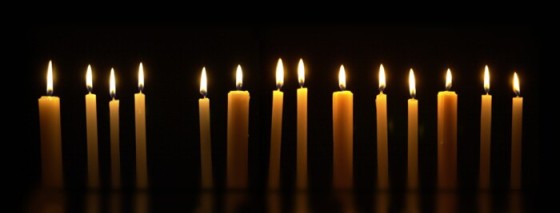
CANDLES            by Constantine Cavafy, translated by David Coomler at
https://hokku.wordpress.com/2016/04/06/the-days-dwindle-down-cavafys-candles/
lineofcandles
The days to come stand before us
Like a row of lighted candles --
Golden, warm, and lively.
The days gone by remain behind,
A sad line of extinguished candles,
The nearest still smoking;
Cold candles, melted and bent.
I don't want to look at them; their form saddens me,
And it saddens me to remember their first light.
I look ahead to my lit candles.
I don't want to turn back, to see and tremble:
How fast the dark line grows --
How fast the extinguished candles multiply.

Sunday, December 13, 2015

The Mystery, from Lyrics of Lowly Life, by Paul Lawrence Dunbar, 1896

Saturday, December 12, 2015

Praising Manners


We should ask God
To help us toward manners. Inner gifts
Do not find their way
To creatures without just respect.

If a man or woman flails about, he not only
Smashes his house,
He burns the whole world down.

Your depression is connected to your insolence
And your refusal to praise. If a man or woman is
On the path, and refuses to praise — that man or woman
Steals from others every day — in fact is a shoplifter!

The sun became full of light when it got hold of itself.
Angels began shining when they achieved discipline.
The sun goes out whenever the cloud of not-praising comes near.
The moment that foolish angel felt insolent, he heard the door close.


"Praising Manners" by Robert Bly from The Winged Energy of Delight

© Harper Collins Publishers, 2005.

Sunday, August 9, 2015

A Reward             by Denise Levertov

Tired and hungry, late in the day, impelled
to leave the house and search for what
might lift me back to what I had fallen away from,
I stood by the shore waiting.
I had walked in the silent woods:
the trees withdrew into their secrets.
Dusk was smoothing breadths of silk
over the lake, watery amethyst fading to gray.
Ducks were clustered in sleeping companies
afloat on their element as I was not
on mine. I turned homeward, unsatisfied.
But after a few steps, I paused, impelled again
to linger, to look North before nightfall-the expanse
of calm, of calming water, last wafts
of rose in the few high clouds.
And was rewarded:
the heron, unseen for weeks, came flying
widewinged toward me, settled
just offshore on his post,
took up his vigil.
                               If you ask
why this cleared a fog from my spirit,
I have no answer.


"A Reward" by Denise Levertov from Evening Train. © New Directions, 1992.